

Subordinate Clauses in German: Master Word Order with 5 Simple Rules


Why Subordinate Clauses Make Your German Better
When you start learning German, you usually speak in short, clear sentences:
“Ich lerne Deutsch.” or “Das Wetter ist schön.”
That’s a perfect starting point!
But as soon as you want to express opinions, explain reasons, or describe goals, you need subordinate clauses. They make your German more fluent, more precise, and more natural. In this article, you’ll learn the most important rule of word order in German subordinate clauses—and understand why the verb always comes at the end.
No matter if you’re at A1, B1, or C1, this guide will help you avoid common mistakes and sound confident, like a native speaker.
What Exactly Is a Subordinate Clause?
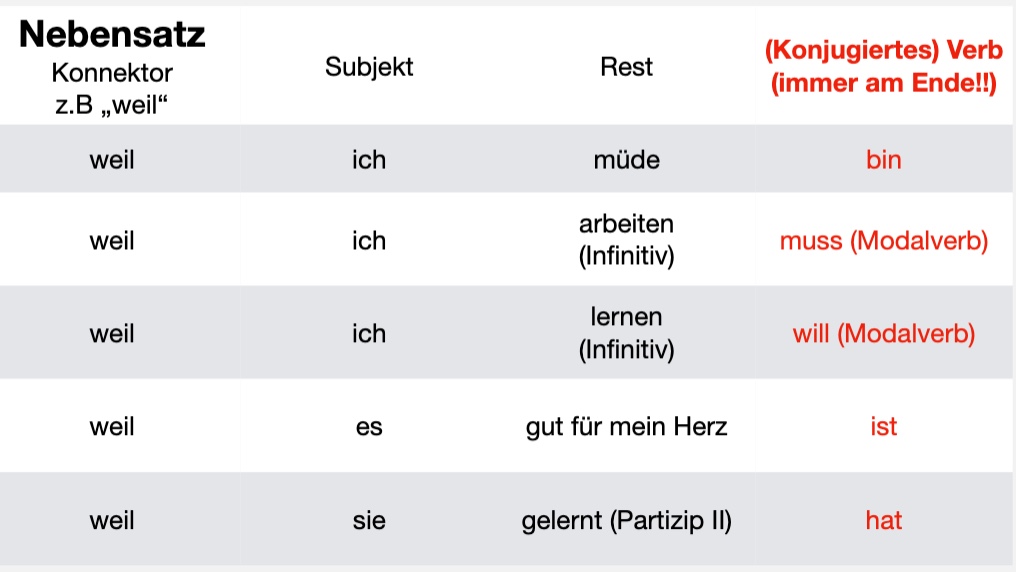
A subordinate clause is a part of a sentence that cannot stand alone. It adds extra information to a main clause. The most important difference between a main clause and a subordinate clause in German is the position of the conjugated verb:
- Main clause: the conjugated verb is in the second position
- Subordinate clause: the conjugated verb is at the end of the sentence
The 5 Golden Rules for German Subordinate Clauses
To keep your word order correct, remember these five key points:
- The comma: In German, a subordinate clause is always separated from the main clause by a comma.
- The conjunction: It almost always begins with an introductory word (e.g. weil, dass), which opens the “bracket.”
- The verb at the end: The conjugated verb moves to the very last position in the subordinate clause.
- Separable verbs: Unlike in main clauses, the prefix and verb stay together at the end.
- Verb position after the clause: If the subordinate clause comes first, the verb of the main clause follows directly after the comma.
| Conjunction | Function | Example |
| weil / da | Reason (why?) | Ich lerne Deutsch, weil ich in Deutschland arbeite. |
| dass | Indirect speech/thought | Ich weiß, dass Deutschlernen Spaß macht. |
| wenn | Relationship/time | Ich rufe dich an, wenn ich zu Hause bin. |
| obwohl | Contrast | Ich gehe joggen, obwohl ich müde bin. |
| damit | Goal/intention | Ich lerne viel, damit ich die Prüfung bestehe. |
Pro Tip for Advanced Learners:
With separable verbs, the prefix moves back together with the verb in subordinate clauses.
- Main clause: Der Kurs fängt morgen an.
- Subordinate clause: Ich weiß, dass der Kurs morgen anfängt.
Special Case: Subordinate Clause in First Position
A subordinate clause can also appear in position 1. In this case, the word order in the following main clause changes:
- Normal: Ich bleibe zu Hause, wenn es regnet.
- Subordinate clause first: Wenn es regnet, bleibe ich zu Hause.
 Classroom tip: Pay attention to “verb-to-verb adjacency.” The two verbs—the end of the subordinate clause and the beginning of the main clause—stand directly next to each other, separated only by a comma.
Common Mistakes – and How to Avoid Them
Mistake 1: The verb comes too early
 Ich lerne, weil ich will eine Arbeit finden.
 Ich lerne, weil ich eine Arbeit finden will.
Mistake 2: Forgetting the comma
In German, the comma before the conjunction is mandatory. It separates the two verbs from each other.
Mistake 3: Incorrect structure after the subordinate clause
Wenn ich Zeit habe, ich komme vorbei.
Wenn ich Zeit habe, komme ich vorbei.
(Verb in position 2 of the complete sentence!)
- Miniquiz: Test Your Knowledge
Answers are at the end of the article.
- Connect the sentences with „weil“: Ich gehe ins Bett. Ich bin müde.
- Put the words in the correct order: (ich / dass / heute / die Sonne / scheint / hoffe)
- Change the beginning of the sentence: „Ich lerne Deutsch, wenn ich Zeit habe.“ → start with „Wenn…“
Answers:
1. Ich gehe ins Bett, weil ich müde bin.
2. Ich hoffe, dass heute die Sonne scheint.
3. Wenn ich Zeit habe, lerne ich Deutsch.
Responses