
Description
Our German C2 course (GER) is offered year-round – online or in person. Since it focuses on applied language, you can join at any time without missing any content. The course trains academic writing, stylistically differentiated speech, idiomatic expression, complex text comprehension, and discussion and argumentation at the highest level.
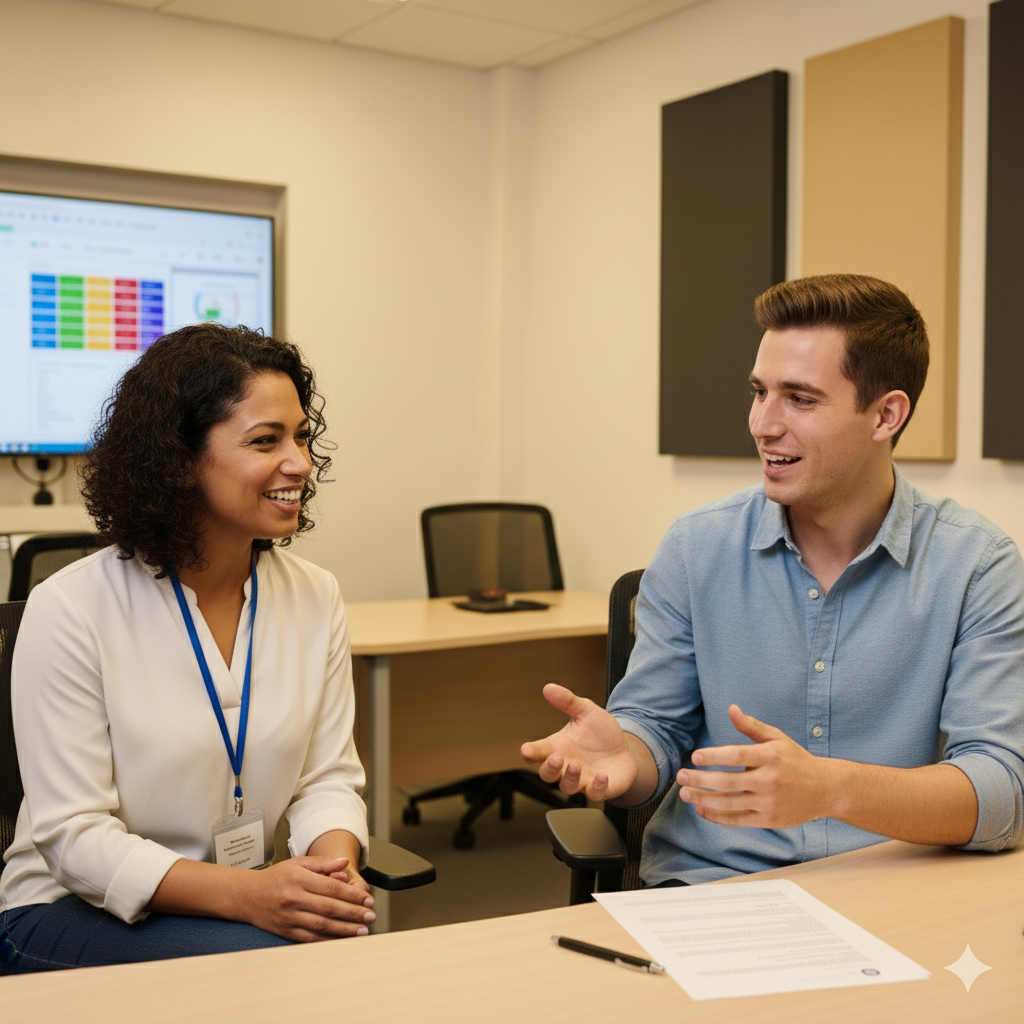
You decide flexibly how long you want to study: 1 month, 3 months, 6 months, or a full year. Classes take place once a week in the evening — ideal alongside work or university. The small-group format guarantees individual feedback from our qualified teachers.
Whether for the C2 German exam, the German C2 certificate, university, your career, or out of personal interest: with this course, you will achieve near-native language proficiency.
Our one-year C2 course covers the following themes:
- Theory and Practice of Communication:
In this module, participants practice advanced conversation strategies, rhetorical techniques, and the subtleties of intercultural communication. The goal is to perform confidently and at the highest linguistic level in discussions, debates, and presentations. - Media: This section covers critical media analysis, language use in traditional and digital media, and the role of social networks. Learners practice taking a differentiated and reflective stance, thereby specifically expanding their expression and analysis skills to C2 level.
- Communication in working life: This module focuses on language in a professional context: negotiating, presenting, writing sophisticated texts, and conducting meetings. It trains both linguistic precision and communicative sensitivity at the highest level.
- Politics & Society: The focus is on discussion and argumentation strategies for current social and political topics, as well as knowledge about Germany’s political system. Participants learn to analyze complex issues in a linguistically sophisticated manner and to present their findings in a convincing way.
- Economics: Here, students work on economic texts, financial language, and economic discourse. They learn to use technical language in a nuanced way and practice formulating complex economic issues precisely and convincingly.
- Tourism and the environment: This module combines intercultural learning with language training. By analyzing travel reports, tourism concepts, and texts on regional studies, participants develop their written and oral communication skills to the highest level.
- Science and technology: The focus is on the language of scientific texts and technical innovations. Participants practice summarizing complex content in a structured way, evaluating it critically, and presenting it themselves in sophisticated language.
- History and Culture: This module focuses on historical events and cultural developments. Learners practice understanding complex historical discourse in a nuanced way and presenting their own viewpoints convincingly.
- Literature and culture: By working with literary texts and cultural discourses, participants deepen their interpretative and linguistic-analytical skills. Creative and critical writing is encouraged at the highest level.
- Philosophy: This module focuses on abstract thought processes and philosophical texts. Participants practice precise argumentation, logical language use, and the ability to formulate complex ideas in sophisticated German.
- Health and psychology: Linguistically demanding texts on health topics and psychological issues are studied. Learners practice presenting complex interrelationships in a comprehensible and differentiated manner and discussing them sensitively.
- Religion: This module explores religious discourse, texts, and societal debates. Participants develop the ability to argue with linguistic precision, reflection, and at the highest level in this sensitive field.
Each of these modules can also be booked individually.
New modules start in the middle of a new month.
Schedule: Wednesday, 18:45-21:15
Reviews
There are no reviews yet.