

Perfekt or Präteritum? When to Use Each Past Tense

Many German learners ask the same questions again and again in class: “Which past tense is correct?” or “Why does the newspaper say ‘er ging,’ but my friend says ‘er ist gegangen’?”
Choosing between Perfekt and Präteritum can feel confusing at first, but with a few simple tips, you’ll quickly feel more confident.
German has two main ways to talk about the past: Perfekt and Präteritum. The good news is that there’s often no difference in meaning. However, there are clear rules for when to use each form—and these rules will help you sound more like a native speaker.
In this article, you’ll learn:
- the difference between Perfekt and Präteritum
- when to use each tense
- and how to avoid common mistake
This guide is suitable for learners from A1 to C1—whether you’re just getting started or refining your German for professional use.

5 Golden Rules for Choosing: Perfekt or Präteritum
- The auxiliary exception: With sein, haben, and modal verbs, you almost always use the Präteritum (war, hatte, musste).
- Structure: Perfekt always has two parts (auxiliary verb + past participle), while Präteritum uses only one word.
- The verb bracket: In Perfekt, the past participle always comes at the very end of the sentence.
Movement matters: In Perfekt, use sein only for movement (from A to B) or for changes of state.
Perfekt or Präteritum? Two Past Tenses – One Goal
Both Perfekt and Präteritum describe completed actions in the past.
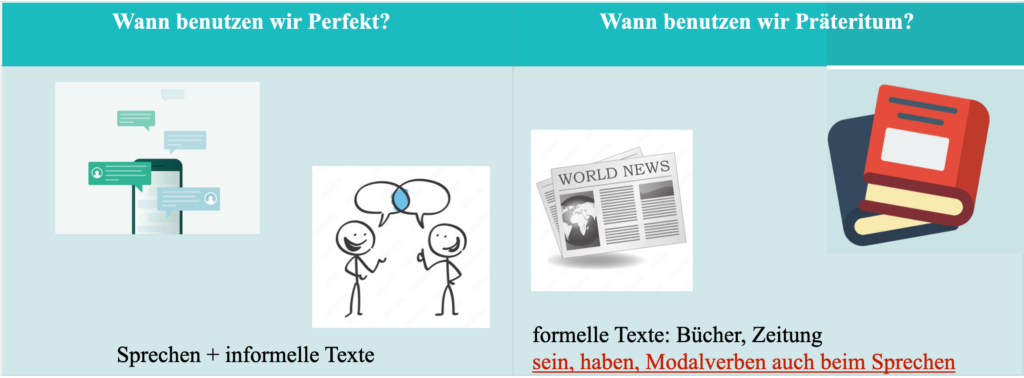
The biggest difference is not what happened, but where the language is used:
- Spoken communication
(conversations, phone calls, voice messages) → Perfekt - Written communication
(books, newspapers, literary texts, reports) → Präteritum
Many learners feel unsure at first—and that’s completely normal. In our German courses, we often see learners using Präteritum in conversation. While this is usually grammatically correct, it sounds very formal or even fairy-tale-like to native speakers.
When do you use Perfekt?
While Präteritum is mainly used in writing, the everyday Perfekt or Präteritum question is usually decided in favor of Perfekt. You use it almost all the time when speaking with friends, family, or colleagues. It’s also the standard in informal writing, such as WhatsApp messages or private emails.
 Remember:
If you ask yourself, “Perfekt or Präteritum?”—in conversation, Perfekt almost always wins.
Listen to real conversations on Deutsche Welle to get a feel for how Perfekt is used in everyday speech.
How Is the Perfekt Formed?
Perfekt is a compound tense and consists of two parts:
- the auxiliary verb haben or sein (conjugated in position 2)
- the Partizip II (at the end of the sentence)
Pro tip from the classroom:
- sein for movement from A to B (gehen, fahren, fliegen)
- sein for changes of state (aufwachen, sterben, einschlafen)
- haben for almost all other verbs
| Infinitiv | Hilfsverb | Partizip II | Beispiel |
| lernen | hat | gelernt | Ich habe viel Deutsch gelernt. |
| gehen | ist | gegangen | Er ist nach Hause gegangen. |
| essen | hat | gegessen | Wir haben Pizza gegessen. |
| fahren | ist | gefahren | Bist du mit dem Bus gefahren? |
Präteritum – The Tense for Texts
When do you use Präteritum?
You mainly find Präteritum in written language. Newspapers, novels, news articles, and reports mostly use this tense. It sounds more distant, factual, and narrative. Even though Perfekt dominates everyday speech, the comparison Perfekt or Präteritum clearly shows that Präteritum is essential for written texts.
The Most Important Exceptions: sein, haben, and Modal Verbs
This is where it gets interesting.
Some verbs are almost always used in Präteritum, even in spoken German, because the Perfekt sounds unnatural or awkward:
- sein: “Ich war gestern im Kino.” (instead of “Ich bin gewesen.”)
- haben: “Ich hatte keine Zeit.” (instead of “Ich habe gehabt.”)
Modal verbs: “Ich musste arbeiten.” (instead of “Ich habe arbeiten müssen.”)
| Infinitiv | Präteritum (ich/er/sie/es) | Beispiel |
| sein | war | Das Wetter war herrlich |
| haben | hatte | Wir hatten viel Glück |
| können | konnte | Er konnte nicht kommen. |
| wollen | wollte | Wolltest du mich anrufen? |
Typical Mistakes – and How to Avoid Them
Mistake 1: Sounding Too Formal
 Gestern kaufte ich ein Brot.
 Gestern habe ich ein Brot gekauft.
Why?
The Präteritum of action verbs sounds stiff and unnatural in conversation.
Mistake 2: Wrong Position of the Participle
Ich habe gegessen einen Apfel. Ich habe einen Apfel gegessen.
Tip:
The Partizip II always comes at the end of the sentence—like a bracket.
Mistake 3: Mixing Up haben and sein
Ich habe in die Stadt gegangen. Ich bin in die Stadt gegangen.
Memory aid:
Movement from A to B → always sein
Practical Tips for Your Daily Learning
Listen carefully:
In podcasts or conversations, pay attention to how often war and hatte appear. You’ll be surprised how frequent they are.
Mark while reading:
Highlight all verbs in Präteritum, then reformulate the sentence orally in Perfekt.
Learn the most important Präteritum forms first:
war, hatte, wurde, as well as the modal verbs (konnte, musste, wollte).
This already covers a large part of spoken past tense.
-
Miniquiz: Test your Knowledge
(Answers at the end of the article)
1. Was klingt im Gespräch natürlicher?
- a) Ich machte Urlaub.
b) Ich habe Urlaub gemacht. - a) Wir gingen spät nach Hause.
b) Wir sind spät nach Hause gegangen.
2. Präteritum von „sein“ oder „haben“
- Früher ________ ich viel Zeit. (haben)
- Gestern ________ ich sehr müde. (sein)
3. Perfekt oder Präteritum?
- Gestern ________ ich keine Lust. (haben)
- Früher ________ er jeden Tag Sport. (machen)
4. Setze ins Perfekt
- Wir fuhren nach Berlin.
→ __________________________________ - Sie kaufte ein neues Buch.
→ __________________________________
- a) Ich machte Urlaub.
Summary & Motivation
Don’t worry if you still mix up the tenses sometimes—native speakers will still understand you.
Rule of thumb:
- Speaking = Perfekt (except war, hatte, and modal verbs)
- Reading = Präteritum
Learning German is a marathon, not a sprint. With every text and every conversation, you’ll feel more confident.
Would you like to improve your grammar in a focused way? In our free grammar courses, we practice these differences with many real-life examples and personalized feedback.
Find out more about our current German courses and choose the level that’s right for you!
Answers
- b
- b
- hatte
- war
- hatte
- machte
- Wir sind nach Berlin gefahren.
- Sie hat ein neues Buch gekauft.
Responses