

Passing the B2 exam: How to prepare yourself optimally (alone & in a course)

Step by Step to a Successful B2 Exam
For many German learners, the B2 exam is an important milestone. With a B2 certificate, you can start vocational training (Ausbildung), advance your career, or simply prove that you can communicate independently in German. An exam is also a strong source of motivation—studies have shown that learners feel more motivated when they have a concrete goal to work toward.
In this article, you’ll learn:
- how to study effectively on your own
- what you gain from a professional exam preparation course
- why combining both approaches works best
Why Is a B2 Exam Preparation Course Worth It?
The first impression many people have when it comes to the B2 exam is, “I’ll just run through a few practice exams – that will be enough.”
But at B2 level, the exam becomes more demanding. It’s no longer just about language knowledge—it’s about strategy, structure, grammar, vocabulary, understanding different text types, and managing exam stress. It’s these topics that you will be taught to deal with in a preporatory course.
1. Speaking Tasks – Overcoming Nervousness and Uncertainty
In the course, you practice typical speaking tasks in a realistic exam setting, including:
- Partnered conversations
- Expressing your opinion on a subject
- Group discussions
- Describing an infographic or setting
One learner once said after a mock exam:
“I didn’t realize how quickly time passes. Only in the course did I learn how to structure my arguments so I could say everything I wanted to say.”
Example from the Course
Assignment (speaking, with 2 minute preparation time):
„Dein Nachbar hört jeden Abend sehr laute Musik. Was machst du? Präsentiere dein Problem und zwei mögliche Lösungen.“
Student’s initial reaction:
„Also… eh… mein Nachbar… äh… Musik… ich kann nicht schlafen.“
After course correction:
„Ich möchte über ein Problem sprechen: Mein Nachbar hört jeden Abend sehr laute Musik. Das ist schwierig für mich, weil ich früh aufstehen muss.
Ich sehe zwei Lösungen: Erstens… Zweitens… Ich empfehle…“
 That is the difference between intuitive speech and professional exam preparation
2. Written Tasks – Feedback on Structure and Language
From B1 level onward, your grade is no longer just based on grammar but also your command of the language. This is judged by the follow characteristics:
- the structure of your argument
- good use of connectors between paragraphs
- appropriate features for different text types
- suitable wording for the introduction and conclusion
Many learners, for example, overlook the conclusion in a formal email.
Example from a Writing Assessment (Request for information):
Incoherent:
„Ich möchte mich über Ihren Kurs informieren. Bitte antworten.“
Improved (B2-Standard):
„Vielen Dank im Voraus für Ihre Antwort. Mit freundlichen Grüßen …“
In the course, you will receive specific feedback on each text, e.g.:
“Paragraph missing,” “Topic not fully addressed,” “Inappropriate style,” “Reasoning too brief.”
Many people only then realize how much they fail to see on their own.
3. Sprachbausteine – The Most Challenging Part of the telc B2 Exam?
Many learners say:
“I understand the gap text, but I don’t know what to fill in!”
This happens because Sprachbausteine test four different skill areas—often at the same time:
|
Area |
Short explanation (simple terms) |
Example |
|
Grammar |
sentence structure, verb forms, connectors |
„…, weil ich keine Zeit habe.“ |
|
Vocabulary (semantics) |
meaning and choosing the right word |
„die Sonne scheint“ |
|
Noun–verb combinations |
fixed word combinations |
„in Betracht ziehen“ |
|
Morphology |
word forms (nouns, adjectives, etc.) |
„effizient → Effizienz“ |
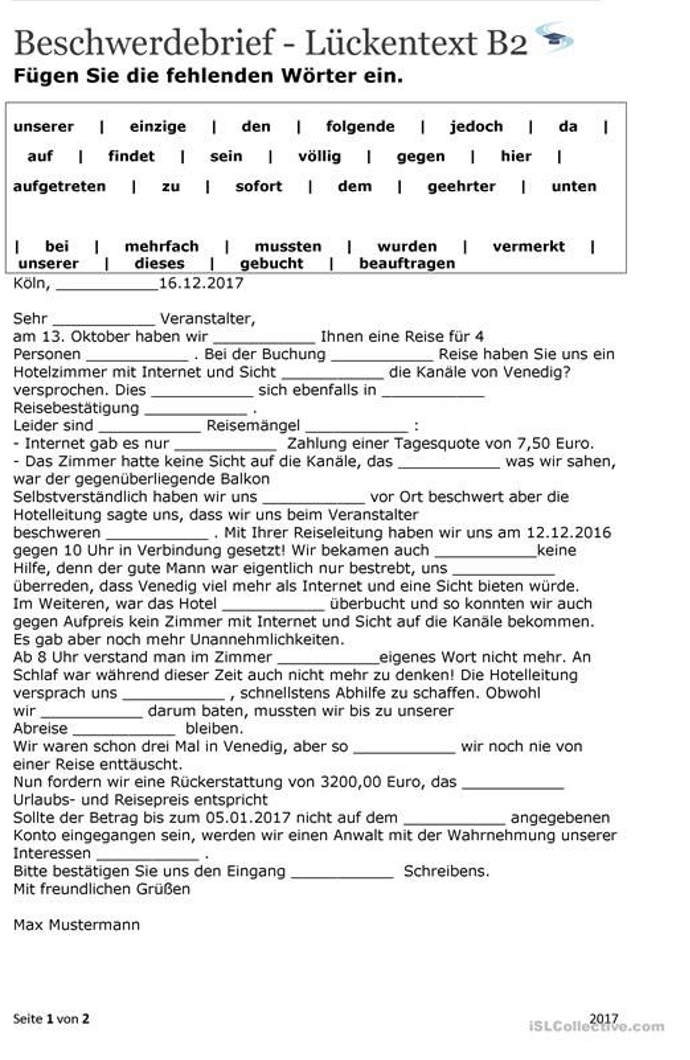
This is why Sprachbausteine feel especially difficult: in one question, you’re being evaluated on several skills.
What Helps with This?
In this type of task, specific topic areas are often tested, such as:
- noun–verb combinations
- passive voice
- connectors with subordinate clauses
- prepositions with accusative, dative, and genitive
That’s why it’s especially helpful to review exactly these areas. And that’s precisely what we do in our B2 preparatory course.
4. Strategies for Listening Comprehension
Listening to texts in the B2 exam often feel fast, complex, or “too authentic.”
That’s because many learners think: “I have to understand every single word.”
That’s not true.
In the course, we train the following strategies:
 Preparation: What’s likely to come?
Before the audio starts, we ask:
- “Which topics match this headline?”
- “Which words do you expect to hear?”
Understanding the main idea instead of every word
Example from a classroom situation:
Learner: “I didn’t understand the word Tischler.”
Teacher: “But did you understand that it’s about a profession?”
→ Global understanding is often enough to choose the correct answer.
Dealing with numbers
Many learners struggle with small details like years or times.
In the course, we practice strategies for identifying and noting down numbers effectively.
Don’t panic if something is unclear
We deliberately practice with difficult listening texts.
After a few weeks, many learners say:
“I stay calm now, even if I miss a part.”
5. Strategies for Reading Comprehension
Here, smart techniques matter more than having a huge vocabulary. We train:
Anticipating content
Before reading, ask yourself: “What could this text be about?”
Understanding words from context
Example from a worksheet:
“The speaker put a lot of work into the presentation. The presentation was well-founded.”
→ By reading the surrounding sentences, you understand: “He was well prepared / supported by facts.”
Sometimes, drawing on other languages can also help (e.g. well-founded, approfondi).
Eliminating incorrect answers
Especially helpful in multiple-choice tasks.
Global vs. selective reading
- Global: understanding the general idea
- Selective: searching for specific information
In the course, you practice both reading styles—under real time pressure.
How You Can Prepare Effectively on Your Own
Of course, you can practice many things independently. The best results come from combining self-study with professional feedback in a course.
1. Know Your Strengths and Weaknesses
Set clear priorities:
- Problems with grammar?
- Insecure about writing?
- Nervous about the speaking exam?
- Listening feels too fast?
At the beginning, do a “mini diagnosis.” We do this regularly in the course as well.
2. Use German in Everyday Life—Every Day!
For example:
- short voice messages to friends
- notes on your phone in German
- podcasts while cooking
- short German videos with subtitles
One student said:
“Since I started writing my shopping lists in German, I think more in the language.”
3. Use Free Online Resources
- telc practice tests
- tasks from exam preparation websites
- YouTube channels for B2 writing or speaking
- vocabulary trainers
4. Ask Native Speakers for Feedback
Don’t ask: “Is this correct?”
Instead ask: “Is the text clear and logical?”
At B2 level, structure matters—not just mistakes.
Also keep in mind: the average native speaker is usually not able to explain grammar rules properly. Without teacher training, people often can’t say why something is right or wrong.
5. Simulate the Real Exam
- use a stopwatch
- work in sections
- no breaks
- no aids
The best combination: self-study + course
Many learners report:
“I practiced on my own, but only in the course did I really understand how the exam is evaluated—and that you can prepare for it strategically.”
A good exam preparation course helps you:
- recognize typical mistakes
- build confidence
- experience realistic exam situations
- understand your strengths and weaknesses
If you also continue practicing at home, your progress doubles.
Conclusion: You Can Pass the B2 Exam—with a Plan and Practice
The B2 exam is demanding, but absolutely achievable.
If you practice strategically, use German regularly, and receive professional feedback, you’ll gain confidence—and be ready for exam day.
If you’d like support:
Our B2 exam preparation course starts in early 2026.
You’ll train all skills in a targeted way, receive individual feedback, and work with realistic exam tasks.
Find out more about our exam preparation courses here!
Responses